

What if leadership wasn’t about surviving pressure, but about building & nourishing the ecosystem around you?
Many leaders I work with are intelligent, committed, and deeply responsible. And yet, under pressure, something familiar happens: attention narrows, urgency takes over, and decisions are made fast – often from tension rather than presence.
This is survival mode leadership.
And it’s far more common than we like to admit.
As I explored in 👉 Why Do So Many Leaders End Up in Survival Mode?,
survival mode isn’t a personal flaw, it’s a biological response. When the nervous system perceives threat, leadership becomes reactive, controlling, and short-term focused.
That response once kept us alive.
But in today’s complex organisations, it slowly drains life from people and systems alike.
This is where regenerative leadership offers a different way forward.
Leadership Is Not a Solo Performance; It’s an Ecosystem
Regenerative leadership starts with a simple yet radical insight:
Leadership doesn’t happen in isolation. It happens in systems.
Just like natural ecosystems, organisations thrive through:
- relationships, not control
- feedback loops, not command chains
- responsiveness, not rigidity
When leaders shift from ego-centric leadership (me, my role, my authority) to eco-centric leadership (the whole system, the long term, collective intelligence), something fundamental changes.
Energy begins to circulate instead of being extracted.
This shift builds on the foundation I described in 👉 What If Leadership Could Feel Different? An Exploration of Regenerative Leadership
where leadership moves away from force and toward vitality, rhythm, and coherence.
Why Ego-Based Leadership Still Dominates (Even When It Stops Working)
The old leadership paradigm – focused on control, speed, and certainty – is seductive. Especially under pressure.
When stakes feel high:
- we centralise decisions
- we move faster
- we rely on familiar authority structures
This is not wrong. It’s nervous system logic.
The problem arises when survival mode becomes the default operating system. Complex challenges require sensing, listening, and adaptability – capacities that simply don’t flourish in chronic urgency.
Regenerative leadership begins by recognising this pattern without judgement – and choosing differently.
The Hidden Cost of Survival Mode Leadership
Leading from ego and urgency often looks effective on the surface. Underneath, it creates quiet depletion:
- Short-term thinking replaces long-term vision
- Psychological safety erodes, so people stop speaking honestly
- Creativity and innovation decline
- Leaders carry more weight alone — and burn out faster
Ironically, the harder we try to “hold everything together,” the more fragile the system becomes.
What Changes When Leaders Move from Ego to Eco
Regenerative leadership isn’t about being softer or less decisive. It’s about leading from presence instead of pressure.
Here’s what shifts:
From reacting to sensing
Leaders slow down just enough to perceive what’s really happening — in themselves, their teams, and the wider system.
From control to stewardship
Authority becomes relational rather than positional. People are treated as contributors, not resources.
From survival to regeneration
Decisions are evaluated not only by outcomes, but by whether they increase or decrease vitality in the system.
This is leadership aligned with life.
Regenerative Leadership Is an Invitation
Leadership in this new paradigm isn’t about having all the answers.
It’s about creating conditions where intelligence, responsibility, and creativity can emerge.
You don’t need to save anyone.
You don’t need to fix the whole system alone.
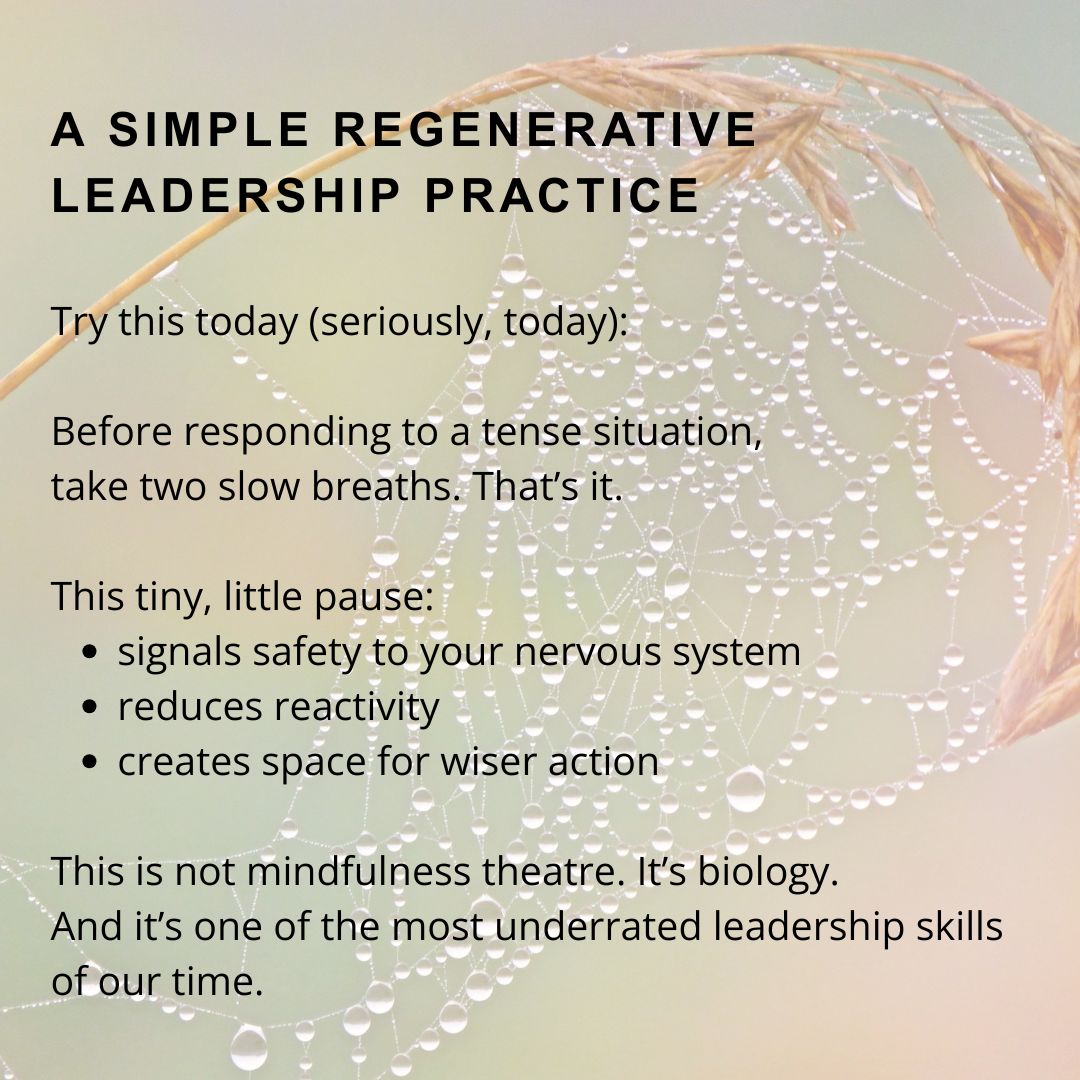
You lead by how you show up, how you regulate your nervous system, and how you relate to the whole.
From ego to eco.
From survival to regeneration.
From control to connection.
That’s leadership for the world we actually want. 🌱
ABOUT THE AUTHOR
Rosalie Puiman is the founder of The Sovereign Leader and the author of The Mindful Guide to Conflict Resolution. She works with executives and founding teams to bring forth effective, impactful and purpose-driven success.