

The world is in turmoil. On the technological field we experience an immense acceleration and growing complexity of the many (many!) systems we should use to stay on top of our day-to-day.
Within our own physical systems, many of us experience overstimulation and emotional exhaustion. We’re getting used to constant change as we’ll see more and more structures and systems collapsing around us.
These old systems include our paradigm around leadership and what it means to be a leader. The controlling, push-based leadership approach is entirely misplaced as new generations enter the workplace, asking for purpose as well as a loser style of directing at the same time.
But it’s not just younger generations. In all organizations I work with, I notice people who are done with the higher and higher burnout rates, human disconnect and unlimited speed & pressure.
As AI brings in support on the one hand and uncertainty on the other, it’s clear that the command-and-control approach is really breaking down. People don’t want to be managed — they want to be lead.
In the midst of all of this, a new form of leadership is emerging. More heartfelt, more human, and potentially a lot more powerful. In this article, I’ll explore this more attuned, regenerative approach to leadership
What is Regenerative Leadership?
Coined by Giles Hutchens, Regenerative Leadership ties in beautifully with what I call sovereignty, and it’s deeply related to the inner alignment and emotional maturity of the leader.
Let’s explore:
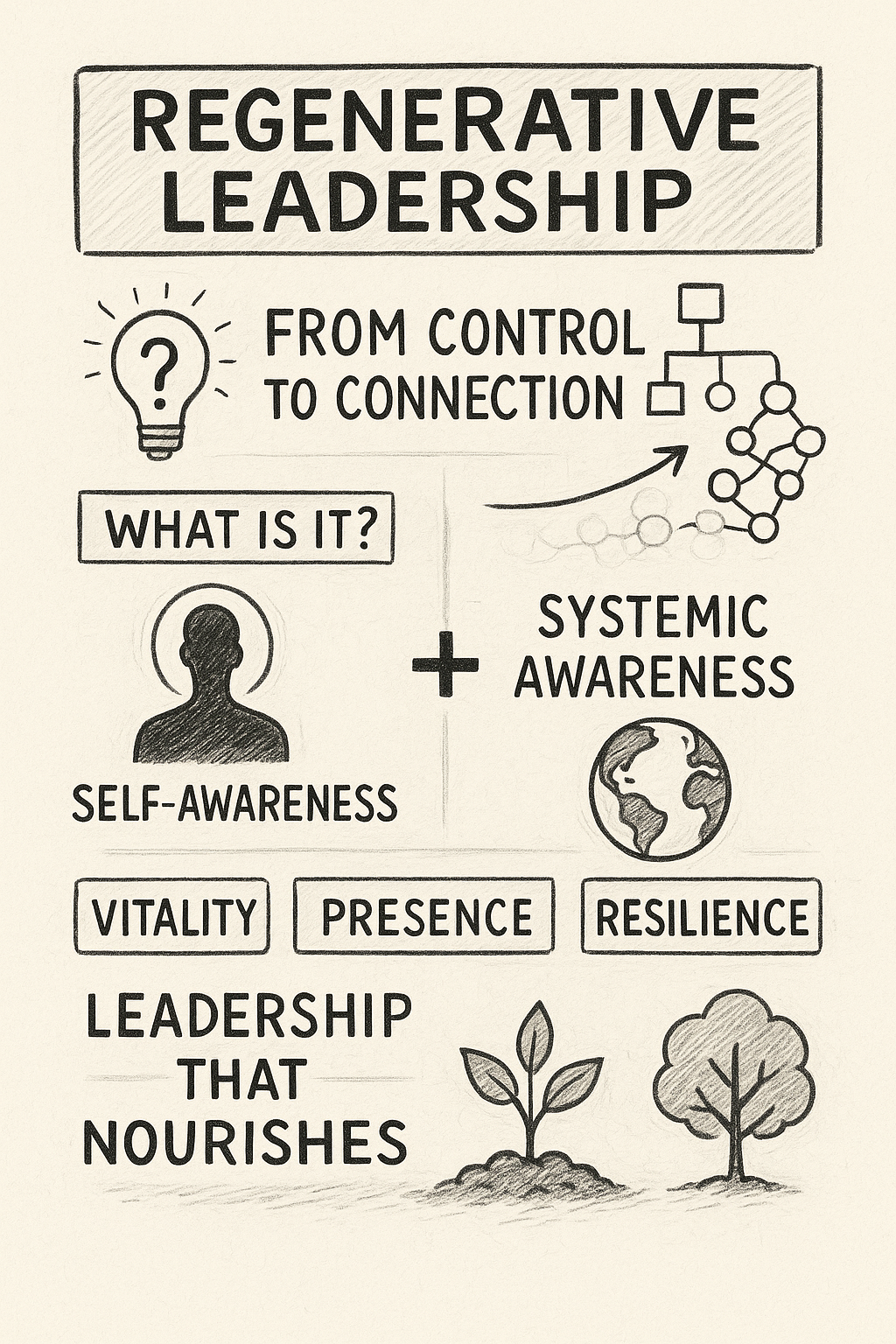
Regenerative leaders draw upon both self-awareness (authenticity & wholeness) and systemic-awareness (sensitivity & wisdom) to cultivate the conditions for regeneration. Moving towards regenerative leadership is a process of becoming more authentic and life-centric — so that leaders don’t just manage tasks, but steward the relationships, energies, and living potentials inside their organizations.
It requires a shift in consciousness — from a mechanistic, separated worldview (where organizations are treated like machines), toward a living-systems worldview (where organizations are seen as interconnected, dynamic organisms), as Hutchins argues here.
Hutchins says: “Regenerative leadership is simply the act of becoming true to ourselves and true to reality, nothing more, nothing less.”
Ultimately, regenerative leadership isn’t just about mitigating harm or being “less bad” (as sustainability often aims for) — it’s about regeneration: enabling growth, flourishing, resilience — people, organizations, society, and nature.
Why this definition matters (and what it means in practice)
- It changes what “success” means: not just profit or efficiency, but vitality, wellbeing, creativity, belonging.
- It calls for leaders to tune into life’s wisdom — cycles, relationships, emergence, not just linear plans.
- It demands inner work: physical presence, emotional maturity, systemic vision — so leaders lead from integrity rather than fear or ego.
- It invites organizations to be living systems — adaptive, alive, evolving — rather than rigid machines.
It’s leadership that begins inside — with the state of your own being — and radiates outward. It asks for leaders who aren’t afraid of authentic expression, who have a grounded, healthy nervous system and dare to truly trust in oneself.
These type of leaders lead from presence and emotional maturity, instead of fear or even panic (a topic I will explore further in an upcoming article).
The ‘Frequency’ of Regenerative Leadership
Keywords for regenerative leadership include:
- spacious
- rooted
- trusting
- rhythmic
- relational
- human
- intuitive
And even though it may be about slowing down, and connecting in, it is NOT…
- passive
- vague
- Woo-woo
- leader-avoidance
- “just be nice to everyone”
It’s actually the most accountable, grounded, and real form of leadership I’ve ever worked with, as well as a natural next step after authentic leadership.
The beauty is that it offers us both a suggestion of how to be as leaders, as well as how to behave so that the ecosystem we lead can flourish.
To close…
Regenerative leadership is leadership that nourishes rather than extracts.It’s life-giving, not life-draining.
In the next post in this series on regenerative leadership, I’ll explore the old style of leadership — the survival-mode style — that many of us were trained in (and many are unconsciously still operating from).
ABOUT THE AUTHOR
Rosalie Puiman is the founder of The Sovereign Leader and the author of The Mindful Guide to Conflict Resolution. She works with executives and founding teams to bring forth effective, impactful and purpose-driven success.